
From a person-centred standpoint, should we be asking clients about their preferences for therapy: for instance, the concerns they’d like to talk about, the style of therapy they want from us, the goals they’re keen to work towards?
It’s a complex question, but an important practical one, and it highlights some of the areas of constructive difference between a pluralistic and a more classical approach to person-centred therapy.
Let’s start with areas of agreement. First, if a client expresses a preference, therapists of any person-centred persuasion (indeed, therapists of most persuasions) are likely to try their best to accommodate it. Second, across both these perspectives, therapists are likely to only offer options that they, themselves, can accommodate. That is, for instance, no one is going to be asking a client if they want EMDR or psychoeducation on sleep hygiene if they, themselves, don’t have those skills and competences. Knowing what we can actually offer—being authentic—is the first step in any preference work.
Where things start to differ, though, is around the question of whether therapists should broach the issue of preferences: that is, proactively asking a client what they might want. Is it appropriate, for instance, for a therapist to ask, ‘What would you like to explore today?’ at the start of a session, or to say to a client, ‘We could explore your feelings to your mother through talking about them, or having a go at expressing them out loud, what would you prefer?’
From a classical standpoint, things emerge naturally, and there is no need to rush the process. Indeed, if we start to probe and ask clients what they want, we may get responses from their conscious, presentational self, rather than from the deeper, and potentially more hidden, elements of their organismic wants and needs. The figure below provides a very simple model of person-centred theory. Here we have the person’s/organism’s actual experiencing, areas A + B, of which B is what they experience and can acknowledge, and A is what they experience but can’t acknowledge. And then we have area C, which are the things that the person thinks they experience, but actually doesn’t. So, for instance, a client thinks that they want CBT techniques because they’ve heard from their friends or social media CBT really works. But maybe, for them, those CBT techniques would actually be really frustrating, or unhelpful. This puts the desire for CBT techniques in area C and, if a therapist then asks the client their preferences—particularly towards the start of therapy—they may end up with responses that bear no reality to what a client actually wants or needs (areas A and B). From this standpoint, what’s essential is to give the organismic experiencing, the growth process time: when clients are ready to ask for what they want, it will emerge—naturally, organically. And no therapist direction is needed: because if the therapist starts to suggest X, or Y, or Z as possibility, it’s going to take the client even further away from their actual organismic wants and needs towards something that, for instance, is there just to please, or conform to, the therapist.
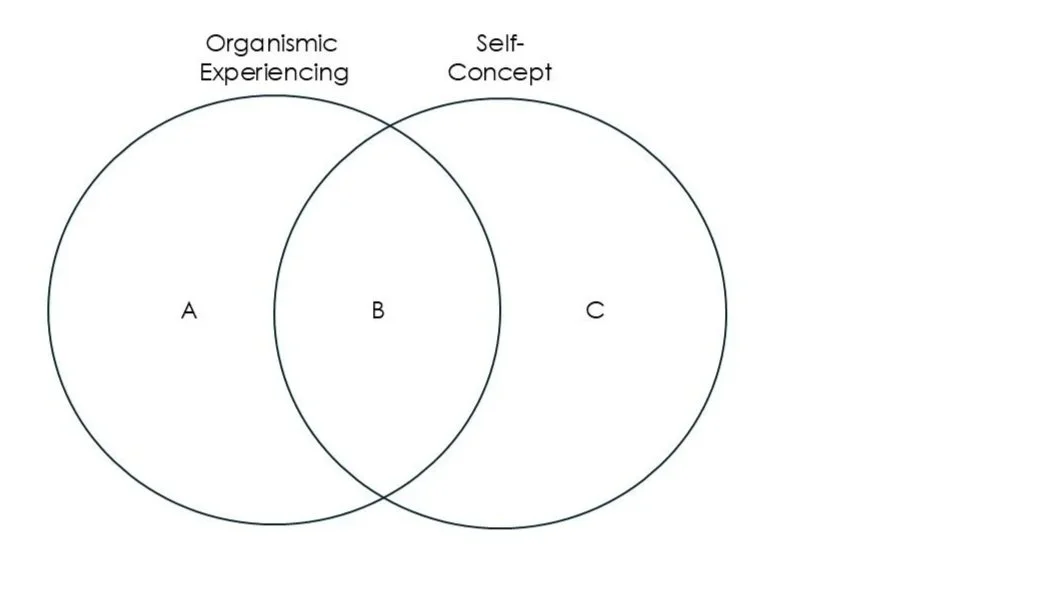
Person-Centred Model of Organismic Experiencing and Self-Concept
That all makes eminent sense but, for me, there’s also challenges with it. First, and perhaps most importantly, from a contemporary postmodern perspective (i.e., that everything is socially constructed) the assumption that there is some ‘neutral’ way of doing therapy would be seen as something of a myth. That is, whether the therapists asks the client their preferences or not, the therapist is still always doing something, still responding in some way, and what they are doing may or may not match what the client’s actual preferences are. Typically, for instance, a person-centred therapist will be engaging in an empathic, accepting, and congruent way. Great… but that is doing (or being) something, it’s engaging in a particular manner, and that may or may not align to what the client is looking for. So if you proactively ask clients their preferences, there’s the potential for preference mismatch, but if you don’t ask there’s also potential for preference mismatch: not asking is not going to just mean that everything is automatically aligned.
As a counterargument, one might suggest that what all clients want and need, most deeply, is an empathic, accepting, and congruent relationship. However, that becomes even more problematic, because then the therapist is saying that they know, most fundamentally, what the client wants and needs, even if the client does not know that themselves. So the therapist, here, is effectively adopting an expert position in a way that threatens to fundamentally undermine the client’s autonomy and sense of self-control: ‘I don’t need to ask my clients their preferences because, ultimately, I know what they need better than they do themselves.’ Again, the point here, from a pluralistic standpoint, is the ‘meta’ one: that a therapist of any orientation, person-centred or otherwise, always holds a position, always has some stance. And once you recognise that, the issue is not whether or not the therapist imposes a choice on the client, but whether or not the client has some choice in relation to the therapist’s pre-decided way of being. If not, if no choice is offered, then that’s less simply allowing the client’s organismic tendencies to emerge; and more ‘imposing’ on the client, in an unreflective way, the therapist’s own choices about what’s right in therapy.
This issue, perhaps, becomes more acute in an era when therapy is often time-limited. With infinite time, the client’s own inner actualising tendency can, perhaps, fully unfurl. There is no need to introduce choices, because the client will come to them naturally themselves. But what if a client has only six sessions, or 12? Then, there are fundamental limits on what is possible, and a therapist’s choice to be one particular way is likely to mean that a client won’t have choices for something else. Again, it comes back to the point that there is no neutrality: if you offer a client, for instance, some relaxation techniques, that is influencing them in some particular way. But, over the course of 12 weeks, if you don’t offer relaxation techniques, that is also influencing in some way—albeit through absence rather than presence.
As a counterposition to this, it could be argued that if a preference didn’t come from the client’s ‘inside’, maybe it wasn’t meant to be. Here, I think classical and pluralistic approaches also tend to have different views of where wisdom is ‘located’: individually, or in the client’s relational field. From a classical standpoint, everything that needs to be known is there, within the client, so why bring in anything, any options, from outside? But if wisdom is relational, then there may be things that the client doesn’t know that may be of genuine healing to them. Here, therapists have the potential to offer options that may be meaningful and valuable, above and beyond what is already in the client’s organismic potential.
Another counterposition from a more classical standpoint: therapists don’t need to ask, explicitly, about clients’ preferences because if they are meeting the client deeply, then they will intuitively sense what it is the client wants and needs. Again, I think there’s a lot of truth in this supposition: through a deep embodied empathy, it is remarkable what can be sensed and intuited in clients. And research, for instance, on mirror neurons shows robust neurocognitive grounds for such processes. And yet, from the psychotherapy research, we also know that therapists’ and clients’ experiences of the therapeutic process, within the same dyad, can be markedly different. For instance, in our own research on relational depth, we found times when therapists (person-centred) experienced a depth of connection with their clients that was very mismatched to the clients’ own experiencing. Overall, the level of matching was actually quite high, but that certainly wasn’t always the case, and this was as much in experienced therapists as trainees. As therapists, then, while we can learn much of what clients want and need from trusting our own intuitive sense of it, from a pluralistic perspective we should never rely on only one source of ‘truth’. Explicit, as well as implicit, conversation would be indicated to develop a more triangulated understanding of what the client wants and needs.
In terms of finding ways forward beyond this dilemma, some thoughts come to mind.
First, being upfront with clients about the way we work is a means of practising from a particular standpoint while minimising the extent to which this might be an imposition on clients. If, for instance, we describe to clients what we do from our classical standpoint—how it’s a space for clients with empathy and acceptance, where they can grow at their own pace, where we won’t be introducing or enquiring into preferences—then it gives clients more power to either choose it or choose against it and look elsewhere. Yes, as a therapist we are still holding a position, but it is a position that is explicit, that clients can see as our position, rather than a truth, and in that sense we’re minimising our power over.
Second, might be the importance of recognising that clients can really vary in how much they want therapists to introduce and ask about different options, and individualising in this way can capture the value of both classical and more pluralistic approaches. From an initial dialogue, for instance, it might become evident that clients really want space in therapy to grow at their own pace without much involvement from the therapist, or it might become clear that they would really appreciate the therapist’s regular check-ins on where they want to go. Of course, the problem here is that to find this out may require initial questions about the client preferences (about preferences), which then gets us back to the issue of whether we should be asking clients what they want or not in the first place. If we believe that wants and needs should be allowed to emerge at their own pace then, by definition, we’re not going to be asking clients what their wants and needs are for that process.
Third, research might be helpful here, asking clients what works for them in terms of these kind of preference discussions. We did a qualitative study of this type and got some interesting initial findings: seeing the range of different responses to preference work, and how it could be experienced as both helpful and not. Again, though, such research could be critiqued on the grounds that participants’ responses are going to come from their self-concept rather than their organismic experiencing (area C), and in that sense not to be trusted. If a client is saying that they valued expressing their preferences, for instance, is that because they want to be liked, or feel obliged to comply with the researcher?
Whatever positive way forward we find here, it’s likely to be in the nuances and complexities, and away from black and white generalisations. It’s true, for sure, that clients can express preferences that don’t genuinely match what they want or what helps them, but it’s also not true to say that that is always the case. Clients can know, and articulate, preferences that are of deep meaning to them, and they can also experience the process of being asked about preferences as deeply empowering. But some can find it disempowering, or even shaming if they don’t know what they want. And, most likely, preference work is not a binary thing (either we do it or not). Also, there may well be a plethora of times in our work when we are, explicitly or not, inviting clients to express and follow preferences. A simple reflection, for instance, like ‘It sounds like you were really hurt by what your mother said,’ may invite a client to consider whether they want to talk more about that hurt or not. The differences across person-centred approaches, then, are likely to be in emphases, in subtleties, in touches of more or lesser ways of explicating. For me, personally, I think it is a willingness to sit with the wholeness of that complexity, and to ask and explore these complex questions, that expresses the essence of what being person-centred means.
Acknowledgements
Photo by Sophia Kunkel on Unsplash
Note
This is something for a future blog but, in many ways, I think the Figure above (with the two circles) can help us make sense of some of the core tensions between classical and more pluralistic approaches to person-centred therapy. A classical approach puts emphasis on A and B, what is organismically there. It trusts that this will emerge, and wants to support the wholeness and authenticity of the individual coming into being. But the problem is, in doing that, it may mean not fully ‘trusting’ what is presented by the client in B (and C): it means looking, potentially, ‘past’ the person in the room with you, and thereby becoming the expert in the room, who knows what the client wants and needs beyond that client’s own understanding. By contrast, a pluralistic perspective tends to emphasise more trust in the client as they are in the room in the here-and-now: the person in front of you. So it’s not about trying to look at who they ‘really’ are, what’s ‘behind’ them, but a respect and valuing for the person then and there, and a trust in their choices and preferences, as they are now. Problem there, though, is that can then over-emphasise the conscious at the expense of what is not stated or known by the client. These aren’t, of course either/or alternatives: ideally we trust both aspects of the client—actuality and potentiality—but there’s inevitably going to be times when these trusts are pulling in different directions: like, for instance, whether we think it is of value to ask the client, in the here-and-now what it is they’re wanting from the therapeutic process. So when we talk about trust in the client’s autonomy, what do we actually mean by the client? Do we mean the person presenting in the room, or do we mean the person they can be? And we might say, ‘Well, obviously, all of this,’ but then what if these ‘parts’ are pulling in different directions? These are, again, complex questions, with no easy answers, but through respectful in-depth dialogue across positions we may, perhaps, be able to move forward to deeper understandings.